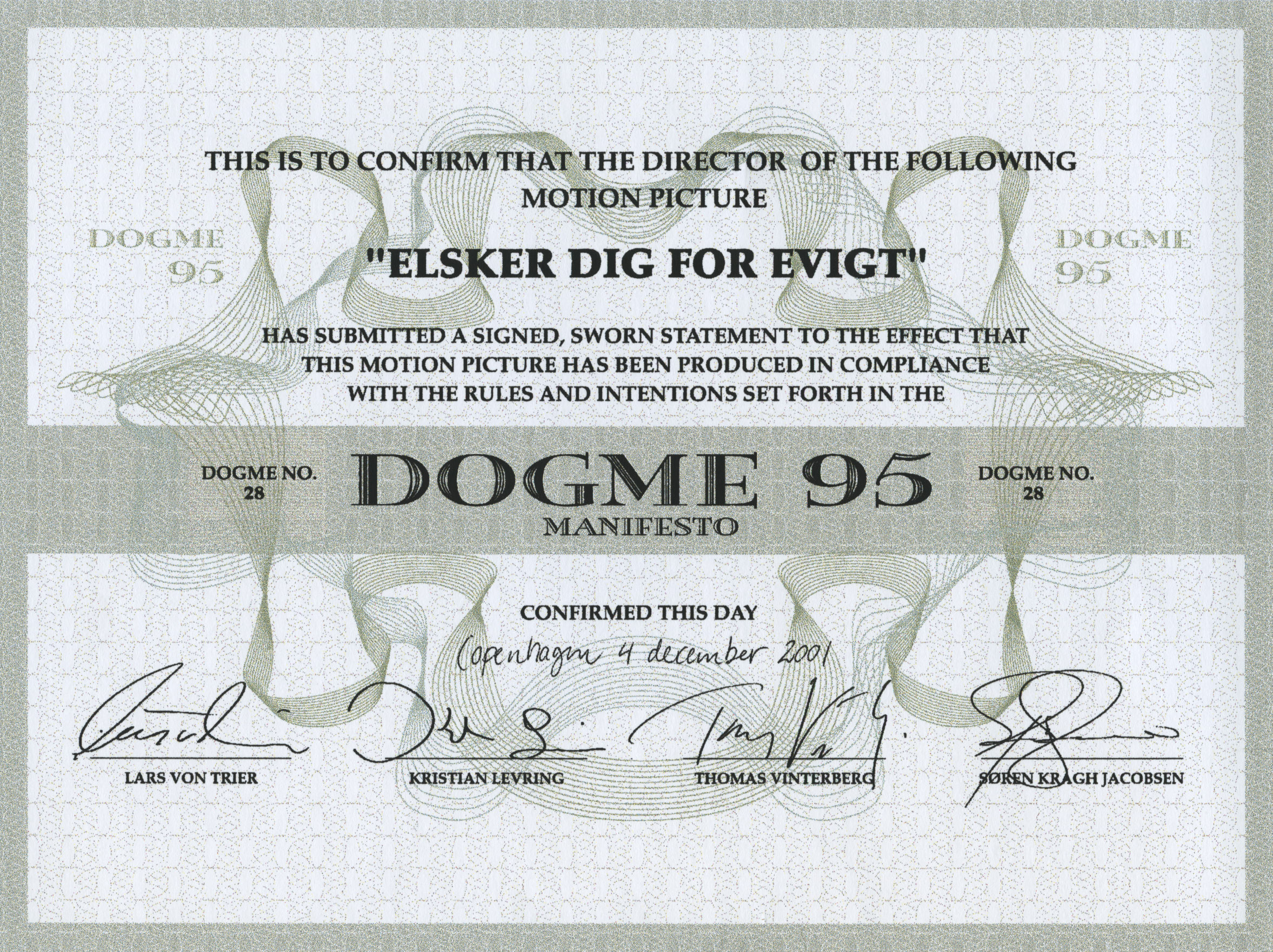
Dogme 95 is a manifesto created by the Danish filmmakers Lars Von Trier and Thomas Vinterberg in 1995, which led to a new form of cinema. They defined the ‘right way of filmmaking’ by determining in the Vow of Chastity a set of ten rules, such as no additional lighting or props (everything must be brought by the shooting location), no music that was not produced by the image, handheld camera, no optical work or filters and the images must be in colour, etc. (find complete list here).
It was conceptualised in opposition to digital cinema and the French New Wave. According to the two Danish directors, the concepts of auteur and special effects compliments a cinema of ‘illusion’, and erase the indexicality of an instant and a story: “we must put our films into uniform, because the individual films will be decadent by definition!” (L. Von Trier, T. Vinterberg, 2014: pp. 305). With the explosion of digital cinema in the 1990s, celluloid was replaced by film, landscapes were replaced by green screens, and costume & make-up was replaced by computer-generated-imagery (CGI). Although it created huge excitement for the audience and directors, some were more reluctant to put the old days aside for a digital revolution.
The Vow of Chastity was then made to conserve the indexicality of the scene and the ‘truth of the instant’. However, we can argue that it wasn’t the main motivation behind the manifesto. Beyond the will of keeping the representation as real as possible, it can also be perceived as an act of rebellion against technological advances on account of nostalgia. The nostalgia of the old methods they are not ready to change: “Dogma 95 arguably exhibits a nostalgia for film’s alleged ability to fix an indexical trace of the moments it records.” (C. Claire Thomson: pp. 69).
 Home
Home 
Leave a comment